The Sentinel of the Rhône
1000 Years of Defiance at Château de Boulbon
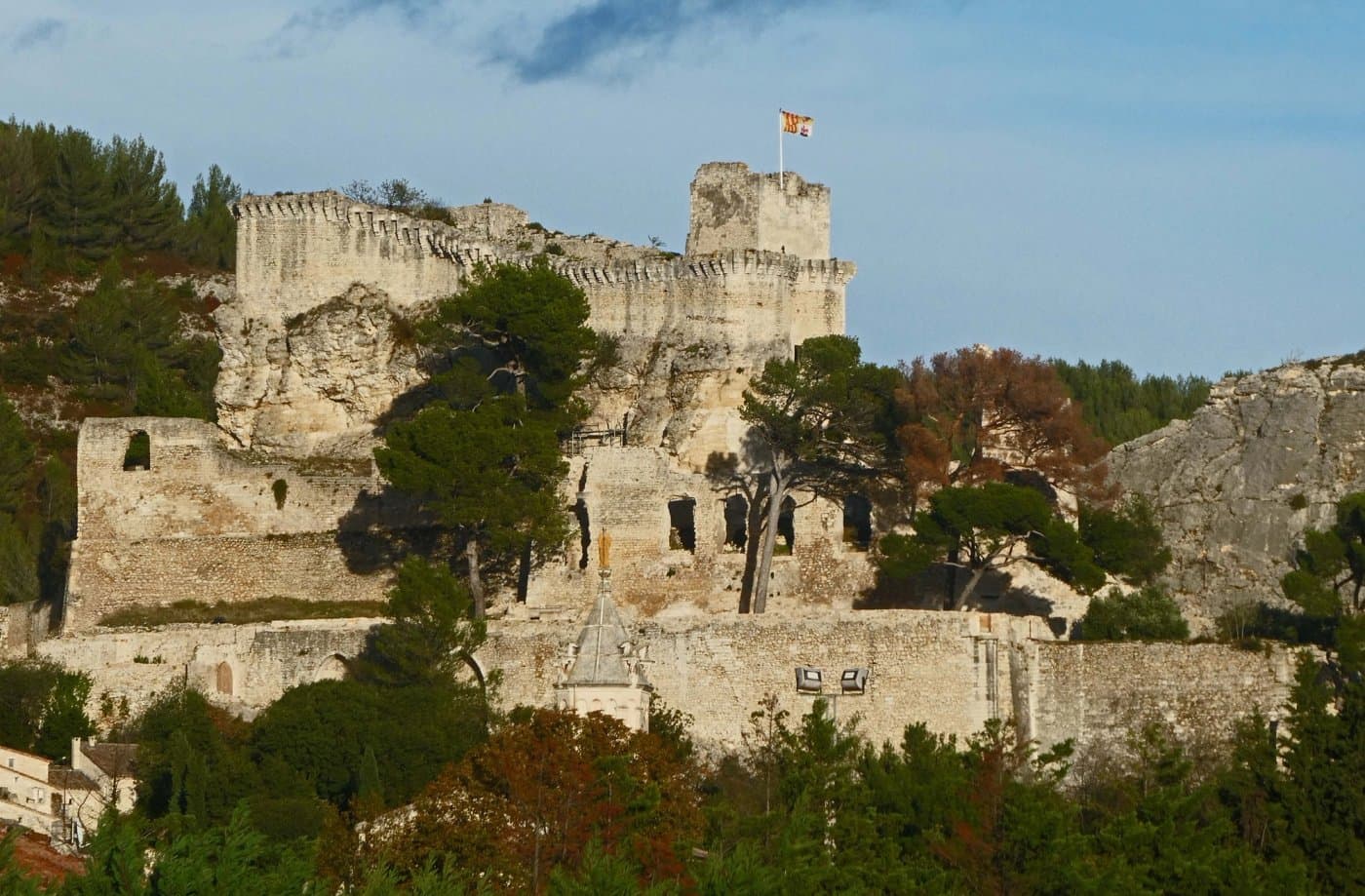
It is not a fairy tale castle. It is an authentic border fortress, carved directly from the limestone cliff of the Montagnette.
A thousand years ago, the Rhône was not a simple river, but a fiercely contested geopolitical fault line between the Kingdom of France and the County of Provence. To monitor its crossings, a primitive castrum was erected as early as 1003.
For centuries, the impressive central Romanesque keep, anchored in the rock, acted as the "sentinel of the river". Its position atop a vertiginous precipice made it impregnable. Medieval builders conceived a defense based on topography: the native stone itself became the primary rampart.
A timeless watchtower, fiercely protecting the borders of its county.
In the 15th century, the purely defensive harshness of the castle yielded to the desire for prestige. This marked the beginning of an opulent era under the House of Anjou.
A scholarly prince, Duke of Anjou, Count of Provence, and sovereign of Naples, "Good King René" acquired the estate in 1457 and made Provence the center of his universe following his Italian setbacks.
He transformed the austerity of Boulbon by infusing it with the emerging spirit of the Renaissance. The southern curtain wall was adorned with spectacular trilobed machicolations, elegant sculpted battlements inspired by the majestic royal castle of Tarascon. The military edifice softened, becoming a residence. The King gathered painters, gardeners, and installed courtly splendor in Provence.
It was in this spiritual and artistic effervescence that the famous Retable de Boulbon was housed, a masterpiece of French primitive art today honored at the Louvre Museum.
Every great river carries its monsters. The local imagination long made the churning waters at the foot of Boulbon the territory of a terrifying mythical figure: the Coulobre. Half-dragon, half-winged serpent, the beast personified the dreadful danger of the Rhône's currents and untamed chasms.
Faced with these dark threats, the need for light gave rise to insistent popular devotion.
Thus was born, in the magnificent pilgrimage chapel of Saint-Marcellin (12th century), a unique ritual that survives with fervor: The Procession of the Bottles, or Saint-Vinage.
Every June 1st at dusk, exclusively among men, inhabitants come to have a bottle of their wine blessed to ward off the dreaded malarial fevers that once ravaged these plains drained by the monks of Montmajour. An invaluable relic where Christian piety and ancient earth-bound traditions fuse in the stone wine.
The incredible defensive bastion would break in the tumult of military cannon fire during the great instability of the 17th century.
During the devastating conflict of the Fronde (1647), pitting noble garrisons against royalist forces, the powerful Romanesque keep endured successive assaults from bourgeois artillery for which no height was now inaccessible, permanently destroying its military invincibility. The residence was battered, the fortress decommissioned.
Yet, as the purely military era ended, an unexpected breath of air came to adorn the harshness of the ruins.
In 1674, Julie de Forbin de la Roque became the owner of Boulbon. Far from warlike concerns, she harbored the ambition to transform the old castrum into a luxurious pleasure residence.
Under her impulse, the rock was finally tamed. She had the very first carriage road cut to allow carriages access to the castle. The austere flank of the hill was dressed in two vast superimposed terraces. A true architectural feat, these unprecedented pleasure gardens were equipped with monumental fountains, themselves fed by the piercing of an ingenious aqueduct.
A parenthesis of elegance in the heart of the Grand Siècle, where the murmur of clear water replaced, for a time, the clash of arms.
The 19th century endowed Boulbon with its most flamboyant figure, that of its last historical representative: Count Gaston de Raousset-Boulbon.
A man of the French nobility driven by the soul of a knight from a bygone era, Gaston left his country to seek fortune, honor, and glory in California. His wild aspirations led him to Mexico, where a foolish project germinated in his pioneer spirit.
In order to found nothing less than an independent colonial republic, he raised an impressive army of European mercenaries. This extraordinary "continental corsair" managed to storm the city of Hermosillo at the helm of his soldiers during an incredible military exploit in 1852.
But the mirage would collapse. Handed over to the Mexican army, Gaston was executed by firing squad on August 12, 1854, writing the last heroic line of this illustrious dynasty on the other side of the Atlantic.
Gradually abandoned by the high aristocracy, the imperial rock became a sleeping colossus.
And when it was thought irredeemably lost, the 21st century saw the opening of an exceptional program of reconciliation. Directed with an iron hand by Dominique de Lavergne, the restoration never obscures the age: the goal is not to rebuild the deceptive, but to stabilize the authentic.
Architect, mason, alone in the face of the immensity of the task, Dominique de Lavergne accomplished everything himself. It is solely by the strength of his hands that he consolidated the colossal 13th-century north rampart and cleared the labyrinthine foundations of the keep facing the bites of the elements.
The sentinel stands tall, observing the Rhône in silence.
THE MYSTERIES OF THE CASTLE
Beneath the 15th-century rampart, a few loose stones hinted at a hidden door. Digging slightly, carved rock was revealed. A monumental undertaking: a vertical shaft 2.5 meters in diameter, carved directly into the bedrock. No trace of plaster... which rules out a cistern.
Could it be a well? An escape tunnel? To date, we have excavated 17 meters deep... and the air is getting terribly thin. We need new equipment to continue exploring the mysteries of the castle.
Help us discover more